
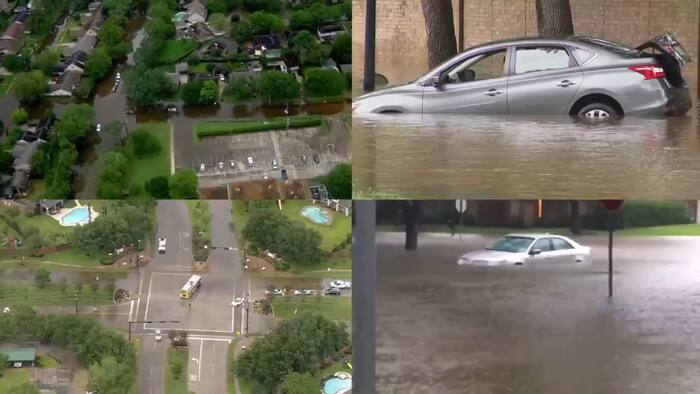
Fort Bend County commissioners have approved another round of drainage and flood-related spending, adding to years of investments intended to protect neighborhoods from rising water.
But a KPRC 2 review of county financial records raises a question for residents who have experienced flooding: How much of the money previously authorized for flood control has been spent, and when will the remaining projects be finished?
The latest approvals, made Thursday, include more than $1 million in drainage maintenance equipment, engineering and repair-related expenses, and services connected to acquiring property for a flood control project near the Brazos River.
The spending comes seven years after voters authorized nearly $83 million in flood control bonds.
County records document completed improvements, projects under development and millions in additional federal funding awarded for drainage work.
The challenge is determining how those investments translate into completed projects and protection for residents.
During their Nov. 12 meeting, commissioners considered several expenditures connected to the county’s drainage system and flood control efforts.
The approvals included approximately $1.09 million for equipment used to maintain drainage areas.
Among the purchases were three John Deere tractors costing $269,465.04, three boom mower tractors totaling $684,164.01, and a trailer costing $138,279.93.
Together, those purchases total $1,091,908.98.
The equipment is intended for drainage maintenance operations, an ongoing responsibility involving waterways and areas designed to move stormwater away from developed properties.
Commissioners also approved nearly $170,000 in flood-related work, including engineering, studies and repairs.
Part of the spending involves a $50,000 matching contribution for Hurricane Beryl-related repairs along Flatbank and Coon creeks.
Another approximately $320,940 was approved for land acquisition services associated with the Brazos River Simonton Pinch Point project.
The distinction is important. The approximately $321,000 figure represents services connected to acquiring property, rather than the purchase price of the property itself.
A review of the commissioners court meeting shows engineering agenda items 33A through 33Y were approved together.
After a motion and second, the presiding official asked whether there was any discussion before calling for a vote.
The items passed unanimously.
Later, during a separate Fort Bend County Drainage District Board of Directors meeting, board members approved additional agenda items through a series of motions and votes.
The recorded proceedings did not include a detailed public explanation of the progress or completion schedules for the county’s major flood control projects during those portions of the meeting.
The absence of discussion during the votes does not establish whether commissioners previously reviewed the proposals or received information outside the meeting.
Still, the approvals provide an opportunity to examine the county’s broader flood control investments.
In 2019, Fort Bend County voters approved $82.9 million in bonds for flood control improvements.
The proposal received support from more than 60% of voters, according to the Fort Bend County Drainage District’s financial report for fiscal year 2025.
The authorization allowed the county to issue debt to finance eligible flood control projects.
But voter approval of a bond proposition does not mean the entire authorized amount was immediately borrowed or spent.
According to the district’s financial report, approximately $25.4 million of the voter-authorized bonds were issued on Dec. 22, 2020.
That represents approximately 31% of the original $82.9 million authorization.
The difference between the total authorized and the amount issued in 2020 is approximately $57.5 million.
That difference should not automatically be described as unspent money. The figures establish the original authorization and the amount issued in 2020, rather than a complete accounting of every subsequent borrowing or expenditure.
Determining the current balance requires an updated breakdown of bond issuances, expenditures and remaining authorizations.
The county’s financial report identifies another significant source of funding.
According to the report, more than $160 million in federal matching funds had been awarded for drainage-related projects.
Those awards represent a substantial funding commitment beyond the original voter-approved bond authorization.
But there is an important distinction between funding awarded and money spent.
A grant award does not necessarily mean the full amount has been received, disbursed or used for completed construction.
Federal grant projects often involve engineering, environmental reviews, property acquisition and other requirements before construction begins.
The county’s financial report indicates grant-supported work was expected to continue over several years.
For residents, the questions involve how much of the awarded funding has been drawn down, which projects have received the money and when construction will be completed.
The Fort Bend County Drainage District’s financial report identifies progress on several projects.
Among the completed improvements listed are drainage channel improvements along the lower portion of Long Point Creek.
The project is one example of work the county reports finishing as part of its ongoing drainage efforts.
Other projects were still in various stages of development as of the district’s fiscal year ending Sept. 30, 2025.
Those included work along the Brazos River, Big Creek and other waterways.
The distinction between completed construction and projects still being designed is central to understanding the pace of the county’s flood control program.
The county’s financial report describes several initiatives in progress as of September 2025.
Brazos River erosion control
The county reported design work involving erosion stabilization at four locations along the Brazos River.
Erosion control work is intended to address areas where moving water threatens riverbanks and surrounding infrastructure.
Upper Big Creek
The district reported final design and right-of-way acquisition activities associated with the Upper Big Creek project.
Right-of-way acquisition involves securing property interests needed to carry out improvements.
Those activities are separate from completed construction.
Mustang Bayou detention improvements
The county identified environmental clearance and site acquisition work associated with a detention project in the Mustang Bayou watershed.
Detention projects are designed to temporarily hold stormwater and manage the rate at which water moves through drainage systems.
Flatbank and Coon creeks
The report identified design and erosion control efforts involving Flatbank and Coon creeks.
The Nov. 12 agenda also included funding connected to Hurricane Beryl-related repairs in those areas.
Other drainage initiatives
The financial report also identified watershed study work involving Upper Big Creek, Seabourne Creek and Robinowitz Ditch.
Additional projects included erosion repair work associated with Kitty Hollow Dam and Ditch H.
These descriptions reflect the county’s reported status during fiscal year 2025. They do not establish the present construction status of each project in November 2026.
The drainage district’s financial statements provide another way to examine its investments.
As of Sept. 30, 2025, the district reported approximately $16.9 million in construction-in-progress costs.
The financial records included balances associated with projects such as Brazos River erosion control, Long Point Creek, Oyster Creek, Big Creek and the Simonton Pinch Point.
Construction in progress is an accounting classification for capital project costs accumulated before the assets are placed into service or otherwise reclassified.
It does not necessarily establish the percentage of physical construction completed.
For that reason, the accounting figure alone does not answer how close individual projects are to completion.
Updated construction schedules and project-level expenditure records would provide a clearer picture.
The financial documents show Fort Bend County has committed substantial resources to flood control.
They identify voter-approved bond funding, federal awards, completed improvements and ongoing projects.
But several questions require more current, project-specific information.
Among them are how much of the original $82.9 million authorization has since been issued, how much bond money has been spent, how much federal funding has been received and used, and whether individual projects remain on schedule.
The records also do not provide one consolidated, current completion date for every major flood control project.
Those details matter because a project approved for funding in one year might require several additional years of engineering, property acquisition and construction.
For residents, the practical question is when the planned improvements will provide their intended benefits.
KPRC 2 is seeking additional information from Fort Bend County about the status of its flood control investments.
The reporting is focused on the amount of previously authorized funding issued and spent, the status of federal grants, updated construction timelines and the expected completion dates for outstanding projects.
The county’s records establish that improvements have been completed in some locations while other projects were still being developed at the time of the latest reviewed financial report.
Thursday’s approvals add new expenditures to the county’s flood control efforts.
But the central question is broader than another vote to spend money.
For Fort Bend County residents, the answer is how much progress has been made, what work is left and when the promised improvements will be finished.
The article separates the November 12 approvals from the 2019 bond authorization, federal grant awards and documented project progress. The county’s fiscal year 2025 project statuses are dated clearly to avoid presenting older information as current.
The central reporting question stays consistent throughout: How much funding has been spent, which improvements are complete and when will residents see the remaining work finished?


