
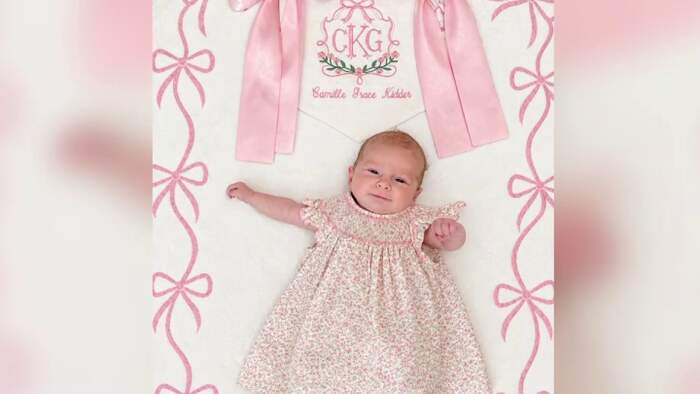
Camille doesn’t know it yet, but she’s already a fighter.
At just 24 weeks in the womb, she underwent a groundbreaking surgery at Texas Children’s Hospital in Houston — a procedure that doctors say has never been performed anywhere else in the United States. Today, she’s three months old, hitting every developmental milestone, and giving her parents in Lafayette, Louisiana something they once weren’t sure they’d have: hope.
When Caitlin Kidder was pregnant, she received news no expectant mother wants to hear. Her unborn daughter had been diagnosed with gastroschisis — a serious birth defect where a baby’s intestines develop outside the abdomen through an opening in the abdominal wall.
But Camille’s case wasn’t just any gastroschisis. It was the complex form — and the statistics are sobering.
“It was just devastating,” Caitlin recalled.
Before the family ever made it to Houston, a doctor back home in Louisiana made a decision that changed everything — she took a second look at Camille’s prenatal scans.
That extra step identified just how serious Camille’s condition was and connected the family with specialists at Texas Children’s Hospital.
Caitlin said she’s texted that doctor repeatedly to thank her.
“She’s like, ‘No, thank them in Texas.’ I’m like, ‘No, thank you — because if you wouldn’t have taken that second look, we wouldn’t have caught it.’”
At 24 weeks pregnant, Caitlin underwent fetal surgery — with surgeons operating on Camille while she was still in the womb.
Dr. Sundeep Keswani, the surgeon who performed the procedure, explained that gastroschisis is actually connected to something that happens in all of us early in development.
“What’s interesting is you and I, when we were at 12 weeks inside of our mother, actually all of our intestines were out too,” Keswani said. “Except ours rotated back in, and unfortunately in these children, the defect persists and they stay out.”
Operating on a fetus’s exposed intestines requires extraordinary precision. The tissue is incredibly fragile — Keswani compared it to overcooked pasta.
“If you can imagine the consistency of a fettuccine — not an al dente fettuccine, like an overcooked fettuccine,” he said. “And you’d be really careful with it, because the last thing you want to do is injure it.”
Even after the fetal surgery, Camille’s journey wasn’t without setbacks. After birth, doctors discovered her intestines had become fused to her skin, creating an additional surgical challenge.
“During her surgery, because her skin was fused to her intestines, they actually had to cut the skin off of her intestine,” Caitlin explained.
During that procedure, Camille suffered a small perforation in her bowel.
Despite it all, she kept fighting.
Camille and her parents recently returned to Texas Children’s Hospital for her three-month follow-up — and the news brought tears of relief.
“Everything looked perfectly normal in her scans,” Caitlin said. “Her weight’s good. She’s eating good. She’s doing all the things, hitting her milestones.”
“It’s amazing. It’s kind of surreal,” she added. “I don’t know that either of us really expected the outcome that we’ve had.”
For Caitlin, Camille’s recovery is the result of both extraordinary medicine and something more personal.
“It’s absolutely thanks to the doctors and science. But also — we had so many people praying for us. Without God and without all the prayers, I don’t know that this would be the outcome that we’re having.”
Camille’s surgery isn’t just her story — it’s the start of something much bigger.
Her procedure is part of the first phase of an FDA clinical trial at Texas Children’s Hospital, with a goal of operating on 10 babies with complex gastroschisis. If the next phase is approved, 20 more babies would be eligible for the procedure.
For the medical team in Houston, Camille is proof of what’s possible — and a glimpse of what fetal surgery may one day mean for families across the country facing the same devastating diagnosis.


